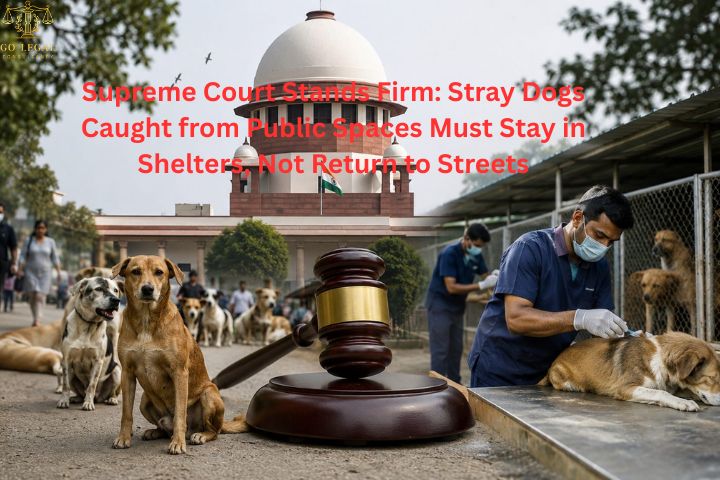
A landmark verdict reaffirms that hospitals, schools, bus stands and railway stations cannot remain hunting grounds for unvaccinated strays. The bench warned of contempt action against officials who fail to act.
On May 19, 2026, the Supreme Court of India delivered a verdict that has , again really, reignited one of the most polarising public policy debates of the decade. The question is still basically the same, who has the first claim on India’s streets. Its citizens, or the ever increasing , swilling population of stray dogs? In a firm, unambiguous order, a three judge bench refused to dilute its earlier directions, which asked for the removal of stray dogs from sensitive public spaces, and it also held that the right to live with dignity necessarily includes the right to pass through a hospital corridor, a school gate, or a railway platform without the constant fear of being mauled .
The ruling, announced by a bench made up of Justice Vikram Nath, Justice Sandeep Mehta and Justice N.V. Anjaria sort of, dismissed a clutch of applications sent by animal-rights groups , dog feeders and welfare organisations that were after modification of the directions originally issued back in November 2025. The court kept its verdict on ice and reserved it on January 29, 2026, after marathon hearings , and now it has finally delivered a judgment that pretty clearly puts human safety first while still protecting the humane care of the animals on their own.
What the Court Actually Ordered
The core of the Supreme Court’s stand is straightforward but consequential. Stray dogs picked up from hospitals, bus stands, schools, railway stations, sports complexes and similar public premises must not be released back to the same spot after vaccination and sterilisation. Instead, they are to be permanently sheltered. This is a clear departure from the long-standing Animal Birth Control (ABC) protocol of “catch-neuter-vaccinate-return,” at least so far as these notified public spaces are concerned.
The court also dismissed petitions that were challenging the Standard Operating Procedure (SOP) issued by the Animal Welfare Board of India , which sort of gives judicial backing to the operational framework that municipal bodies must now follow. Feeding of dogs on public streets still remains barred, except at those places that are specifically marked by local authorities, for that exact purpose.
Crucially, the bench made compliance non negotiable . Any officer or civic body functionary who doesn’t implement these directions faces contempt of court proceedings as well as departmental disciplinary action. By personally tying enforcement to the careers of municipal officials, the court has effectively shut the bureaucratic escape routes that have historically dulled similar orders.
The Case That Began with a Headline
The proceeding carries an unusually evocative title: In Re: ‘City Hounded By Strays, Kids Pay Price’, SMW(C) No. 5/2025. The “SMW” stands for Suo Motu Writ, meaning the Supreme Court started the case on its own motion, prompted by a set of news reports that talked about fatal and disfiguring dog attacks on children across multiple Indian cities. The title framing, by itself, gives the whole posture of the court; this is not your usual public interest litigation, it is more like a judicial nudge, set off because the court thought the administrative will had kind of broken down.
In November 2025, the bench issued its first set of directions, ordering authorities to clear public-utility zones of stray dogs and shift them to shelters. Predictably , the order drew quick opposition from animal-welfare organisations, who claimed that wholesale removal ran against the 2023 ABC Rules framed under the Prevention of Cruelty to Animals Act , 1960, and that confining strays in shelters that were already over-crowded actually amounted to cruelty. These objections ended up as modification applications, which are now decisively rejected.
Why the Court Refused to Budge
Reading from the bench, Justice Sandeep Mehta articulated the constitutional rationale in stark terms. “The right to live with dignity,” he observed, “includes the right to live freely without the fear of being bitten by a dog. The State cannot remain a silent spectator.” The court said it could not “shut its eyes to the bitter ground reality” where children, the elderly, and even international travellers had become victims of dog attacks.
The bench cited reports of toddlers being mauled to death, senior citizens being savaged near their own homes, and tourists being attacked at airports and inside residential complexes. The judges concluded bluntly that the menace had “spread to crucial public spaces, including airports and residential areas,” and that the repetition of such incidents indicated systemic non-compliance with the earlier directions rather than any inadequacy of the directions themselves.
Underneath all the legal reasoning there is still a sober factual record, and honestly it reads a little simpler than people expect. India accounts for about a third of the world’s yearly rabies deaths, and dog bites end up triggering millions of post exposure prophylaxis , PEP shots , every single year. Community data from big metropolitan areas has repeatedly shown a steady, year over year increase in reported bite cases, especially those involving children under twelve. In these situations children are smaller physically and they are more likely to provoke a defensive reaction from a territorial dog.
What This Means for Animal-Welfare Activists
The verdict is, undoubtidly, a setback for organisations that have campaigned for a strictly catch-neuter-vaccinate-and-return style. Their thing has been, for quite a while, that when dogs get removed from their territories there is this “vacuum effect”, where new dogs drift in from nearby areas—often not vaccinated— and the whole issue ends up getting worse. They have also brought up real worries about the capacity, hygiene , and money situation of municipal shelters.
The court did not really get into those operational anxieties in depth, yet its silence on them is kind of instructive. By pushing shelter-confinement for dogs picked up from notified spaces, the bench has shifted the responsibility onto civic bodies to build adequate infrastructure, and not onto activists to keep arguing the same policy again and again. Now state governments and urban local bodies will have to boost shelter capacity, put more into veterinary care , and figure out sustainable funding mechanisms, otherwise they could face contempt proceedings for what happens if they do nothing.
A Larger Constitutional Conversation
The judgment is also a quiet but significant statement on the architecture of fundamental rights. Article 21 of the Constitution guarantees the right to life and personal liberty, and Indian courts have steadily expanded its scope to include the rights to health, dignity, clean air and freedom from noise pollution. By reading “freedom from the fear of being bitten by a dog” into Article 21, the bench has, in effect, recognised public-space safety as a constitutional entitlement.
That has implications well beyond stray dogs. It strengthens the legal foundation for citizen action against any environmental or civic hazard that the State has tolerated through neglect, whether stagnant water that breeds disease, broken footpaths, or unsafe pedestrian crossings. The judgment thus joins a growing body of jurisprudence that treats the failure to maintain liveable public spaces as a violation of fundamental rights, not merely a municipal lapse.
The Road Ahead
For ordinary citizens, the practical takeaways are immediate. Parents anxious about school zones, commuters wary of railway platforms and patients walking into hospital compounds can now demand visible enforcement, and they have judicial backing if the response is sluggish. Resident welfare associations, school managements and railway authorities are likely to step up complaint mechanisms to local municipal corporations.
For policymakers, the next twelve to eighteen months will be decisive. They will need to publish region-wise shelter expansion plans, define designated feeding zones in consultation with welfare groups, and create transparent dashboards reporting capture, vaccination and sheltering statistics. The Animal Welfare Board of India, whose SOP has now survived judicial scrutiny, is expected to issue refined operational guidance to align municipal practices with the court’s standards.
The Supreme Court has, in this verdict, drawn a clear line. Compassion for animals and protection of human life are not opposing values; they coexist in a humane civic order. What the court will no longer tolerate is the use of one to justify the abandonment of the other.
Frequently Asked Questions
Q1. What did the Supreme Court rule on May 19, 2026? The court refused to modify its November 2025 directions requiring stray dogs caught from public places like hospitals, schools, bus stands and railway stations to be kept in shelters rather than released back to the same location.
Q2. Which bench delivered the verdict? A three-judge bench of Justice Vikram Nath, Justice Sandeep Mehta and Justice N.V. Anjaria.
Q3. What is the case title? In Re: ‘City Hounded By Strays, Kids Pay Price’, SMW(C) No. 5/2025, a suo motu writ initiated by the Supreme Court itself.
Q4. Does this overturn the Animal Birth Control (ABC) rules? Not entirely. The catch-neuter-vaccinate-return model still applies generally, but dogs picked up from notified public spaces must now remain in shelters.
Q5. Can people still feed stray dogs on the street? Only at locations specifically designated by local authorities for feeding. Random street feeding remains barred.
Q6. What happens to officials who don’t comply? They face contempt of court proceedings and departmental disciplinary action.
Q7. Was the Animal Welfare Board’s SOP struck down? No. The court dismissed petitions challenging the SOP, effectively upholding it.
Q8. Why did the court refuse to soften the order? Citing repeated dog attacks on children, the elderly and even international travellers at airports and residential areas, the bench concluded that the menace had become severe and that earlier directions were being poorly enforced.
Q9. What constitutional right did the court invoke? The right to live with dignity under Article 21, which the bench held includes the right to move freely in public spaces without fear of dog bites.
Q10. What should citizens do if civic bodies fail to act? They can approach local authorities and, given the judgment’s enforcement teeth, escalate to courts seeking contempt action against non-compliant officials.